

Is there a pose for that?
What if the benefits of yoga are bigger than any single pose?
A student recently asked me a question, versions of which I suspect most yoga teachers have heard many times before:
“Is there a yoga pose that’s good for migraines?”
Sometimes it’s migraines. Other times it’s anxiety, arthritis, low back pain, poor sleep, or tight hips. The details change, but the underlying question is often the same. Which pose should I do? Or perhaps, which pose should I avoid?
These questions make perfect sense. We naturally look for solutions, and yoga is often presented as a collection of tools that can be prescribed for particular problems. Tight hips? Try pigeon pose. Feeling anxious? Forward folds might help. Low back pain? Avoid this, do that.
The challenge is that human beings rarely work in such simple ways.
As yoga teachers, it can be tempting to search for direct relationships between particular postures and particular outcomes. Yet when we look at the research, a much more interesting picture begins to emerge. Yoga appears to help many people, but often not for the reasons we assume. The benefits may be less about a single posture, muscle, or technique, and more about the overall experience of practice.
[Premium members - click the play button above the introduction to listen to the audio version of the newsletter and make sure you scroll all the way to the end to download your exclusive printable Quick Reference teaching guide on “Is there a pose for that?]
Three ways to train with me, when you’re ready…
Study live online:
Join me for a live training, from my Demystifying Aging workshop in July, to the Teaching with Confidence series in September, and my Anatomy Applied to Yoga 6-Week Course starting in October. All designed to support clearer, more confident, evidence-based teaching. Reserve your spot today.Train in person:
I’ll be running trainings in Zürich, Yorkshire and Cheltenham this month. Interactive, evidence-based workshops designed to help you teach with clarity and confidence. Book your place (spots limited).Join the Enlightened Yoga Collective:
Free 1-week trial. On-demand, teacher-focused lessons and a supportive community to help you plan and teach with confidence. Start your free trial.
👉What does the research say?
The encouraging news is that a growing body of research supports the potential benefits of yoga across a wide range of outcomes. Studies have reported improvements in stress, anxiety, mood, chronic low back pain, balance, physical function, and quality of life (Cramer et al., 2018; Wieland et al., 2017; Youkhana et al., 2016).
There is also evidence that yoga may positively influence several cardiovascular disease risk factors. Systematic reviews have reported improvements in blood pressure, resting heart rate, cholesterol levels, blood glucose regulation, and overall cardiovascular risk profiles (Cramer et al., 2014; Hartley et al., 2014).
While yoga is not a replacement for medical care, these findings suggest that regular practice may contribute meaningfully to health and wellbeing.
What I find particularly fascinating, however, is that researchers are often more confident about the outcomes than they are about the precise mechanisms responsible for them.
In other words, yoga appears to help many people. Explaining exactly why is where things become more complicated.

👉Why is the answer so complicated?
When someone asks whether a particular pose is good for migraines, they are often looking for a straightforward cause-and-effect relationship. If I do this movement, will it improve this symptom?
Sometimes the answer may be yes. Many students genuinely report that certain practices feel helpful. Their experiences matter and should not be dismissed.
At the same time, health outcomes are rarely driven by a single factor. Symptoms can be influenced by sleep, stress, physical activity levels, expectations, confidence, previous experiences, social support, and countless other variables. Anyone who has worked with students for long enough has seen this complexity in action. A practice that feels wonderful one day may feel entirely different the next.
Rather than being frustrating, I think this complexity is part of what makes yoga so interesting.
👉Looking beyond the pose
This complexity creates another challenge for researchers.
If a study finds that yoga helps a particular group of people, what exactly produced the benefit? Was it the movement? The breathing? The relaxation? Better sleep? A greater sense of confidence? A combination of all of these?
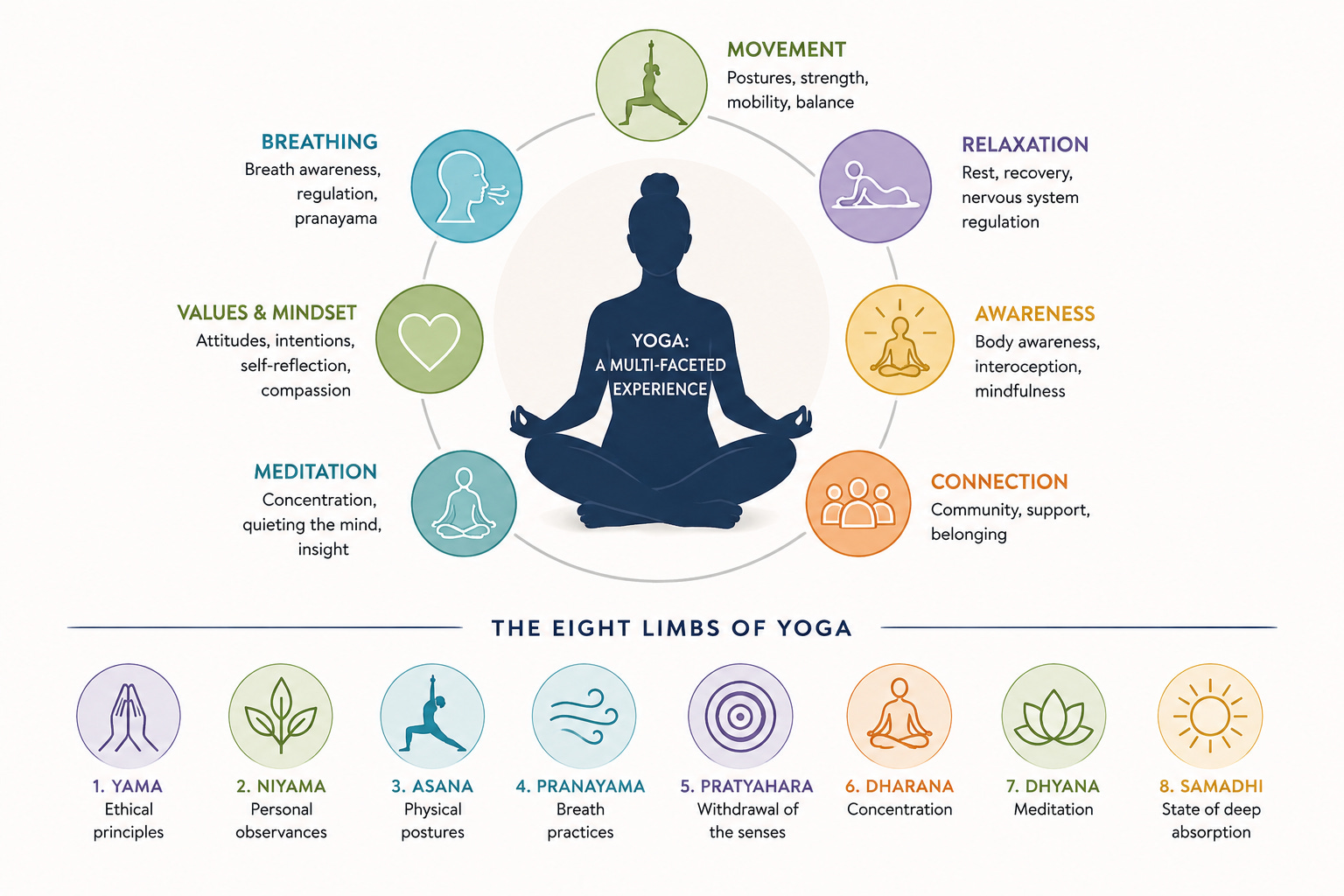
One reason this question is so difficult to answer is that yoga is rarely a single intervention. When researchers study yoga, they are often studying a combination of movement, breathing practices, meditation, relaxation, mindfulness, and home practice. Interestingly, newer research frameworks are increasingly moving away from viewing yoga as a collection of individual techniques and toward understanding it as a multi-component practice that combines movement, breathing, meditation, awareness, and self-care (Wahlström et al., 2026).
One ingredient that is often overlooked is awareness itself. Many yoga practices invite students to notice their breathing, bodily sensations, patterns of tension, emotional responses, and habits of attention. Over time, this may support greater awareness of what is happening within the body and mind (Mehling et al., 2012). Awareness does not automatically solve problems, but it may influence the choices people make and how they respond to challenges.
Connection may be another important ingredient. While discussions about yoga often focus on muscles, fascia, breathing, or physiology, many students come to class for reasons that extend beyond the physical practices themselves. Yoga can provide routine, community, support, friendship, and a sense of belonging. Research from outside the yoga world consistently suggests that social connection plays an important role in health and wellbeing (Holt-Lunstad et al., 2010).
This idea becomes even more interesting when we remember that yoga has traditionally been understood as much more than physical exercise. Postures are only one aspect of a broader practice. The classical eight-limbed model includes ethical principles, self-reflection, physical practices, breathing practices, concentration, meditation, and states of deep awareness.
Perhaps this is one reason researchers often find it easier to identify outcomes than mechanisms. A systematic review by Cramer and colleagues (2016) found that different yoga styles appeared to produce broadly similar outcomes, suggesting that personal preference and accessibility may matter more than finding the "perfect" style of yoga. Yoga may not be a single ingredient at all. It may be an experience created by many different elements working together.
👉Why this matters for yoga teachers
This brings us back to the student with migraines.
If we are honest, there may not be a universally therapeutic pose for migraines. There may not be a universally therapeutic pose for anxiety, arthritis, or low back pain either.
That does not mean yoga cannot help. Quite the opposite.
Research increasingly suggests that yoga can support physical health, mental wellbeing, cardiovascular health, movement confidence, and quality of life. The challenge is that these benefits often emerge from the whole experience of practice rather than a magical posture prescription.
As teachers, perhaps our role is not to identify the perfect pose for every symptom. Perhaps it is to help students explore what works for them. To create opportunities for curiosity, experimentation, and self-discovery rather than promising a one-size-fits-all solution.
👉In summary
Yoga does not need a special pose for every symptom in order to be valuable.
The evidence suggests that yoga can support many aspects of health and wellbeing. The challenge is that these benefits often emerge from the whole experience of practice rather than a single posture, muscle, or technique.
Perhaps the more interesting question is not:
“What’s the best pose for this?”
but:
“What seems helpful for this person?”
Can I ask you a quick favour? If you enjoyed this post, please tap the heart at the bottom of the email. This helps my writing reach more people.
Ready to deepen your applied anatomy knowledge and become more confident in your teaching?
Join me for an in-person training this month and learn in a supportive environment.


