

Rethinking stretching in yoga
What every yoga teacher should understand about flexibility and tightness.

Stretching is woven into almost every yoga class.
We talk about releasing tight muscles, opening the body, and improving flexibility. Over time, many of these ideas become familiar, and rarely questioned.
But when we look a little more closely, some of the common explanations around stretching and tightness begin to feel less clear.
For example, you may have heard that tightness is stored in the fascia rather than the muscles, that fascia can become stuck if we do not stretch regularly, or that certain styles of yoga specifically target fascial tissue. You may also have come across the idea that massage or foam rolling helps to break down adhesions in the tissue.
These ideas are widely shared and often presented with confidence.
But how well do they actually reflect what we understand about the body?
And perhaps more importantly, how do they influence the way we teach?
Rather than asking whether stretching is good or bad, it may be more useful to step back and look at what is actually happening when someone feels tight, and why that experience can change so quickly, even within a single practice.
This shift in perspective does not require you to change everything you do.
It simply offers a different lens through which to understand movement, sensation, and the choices we make as teachers.
And the exciting news is that on May 13th I am hosting a free live 1-hour training where we will explore these ideas in a clear and practical way.
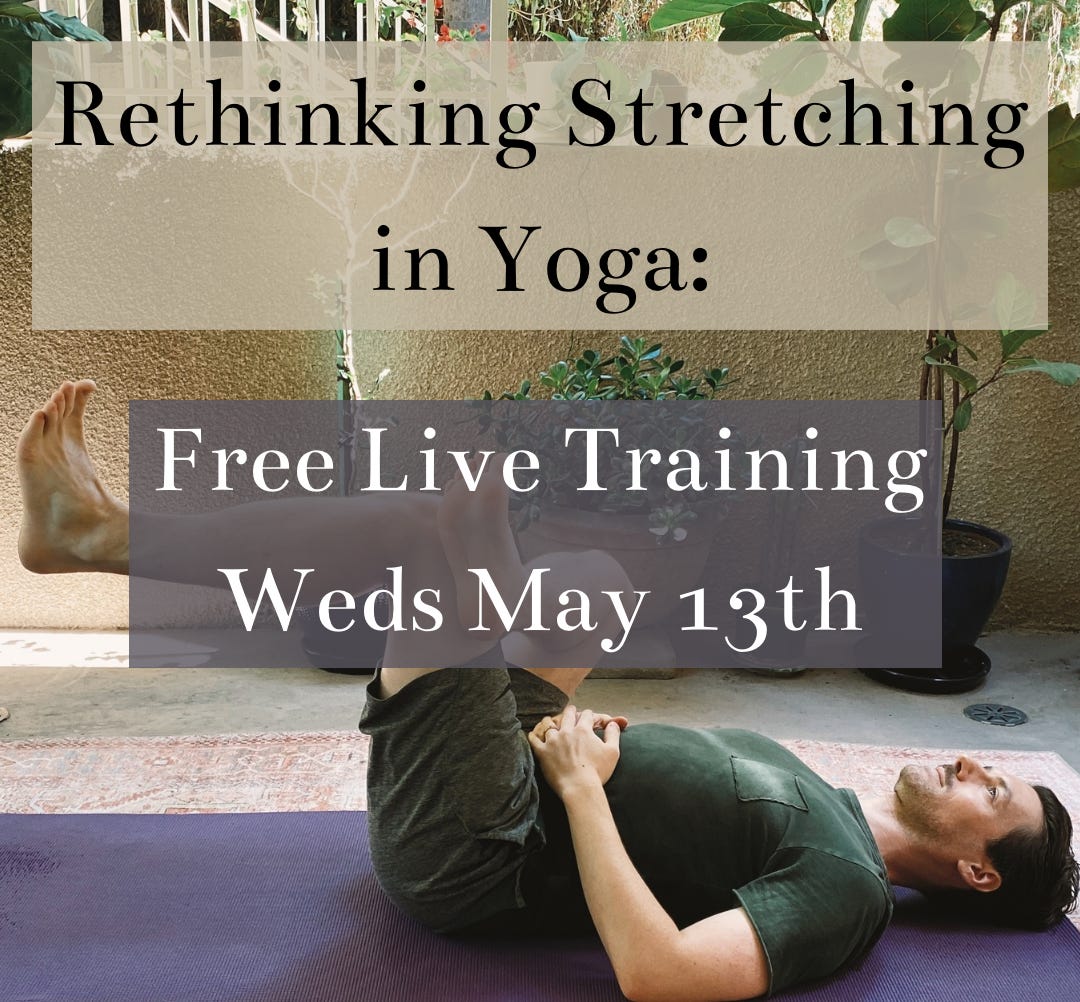
🗓 Date: Wednesday May 13th
⏰ Time: Eur: 8.00 pm, UK: 7.00 pm, East Coast US: 2.00 pm, West Coast US: 11.00 am
📍 Online via Zoom
Can’t join live? No problem! RSVP and you’ll automatically receive the replay.
In this session we will question some common assumptions, explore what may be happening beneath the surface, and consider how this might influence the way we teach.
We’ll cover:
• What we really mean when we talk about “tightness”
• Why stretching does not always change tissue in the way we assume
• The role of the nervous system in flexibility
• Why people can feel tight without having “short” muscles
• Common misconceptions around fascia and tightness
• How strength, control, and exposure to load influence range of motion
• How to think about these ideas in the context of teaching yoga
This is less about replacing what you already do, and more about seeing it a little more clearly.
At the end of the training, I will also briefly share details about my upcoming in-person workshops and my 6-week live online course, Anatomy Applied to Yoga, which begins in October.
Please feel free to share this training with any of your yoga teacher colleagues.
I hope to see many of you live online on Wednesday!
Andrew
P.S. Can’t make the live time? Sign up here anyway — I’ll send you the replay.