

Teaching aging bodies with confidence
6 things every yoga teacher should understand about strength, balance, and adaptability with age.
Many yoga teachers have been taught to approach aging primarily through caution. Less intensity. More props. Smaller movements. Fewer challenges. And while appropriate modification absolutely matters, aging bodies often need more than protection. They need challenge, exposure, confidence-building experiences, and opportunities to adapt.
The problem is that many cultural narratives around aging encourage us to expect inevitable decline. We often assume older adults should avoid instability, avoid loading, and move within increasingly narrow limits of “safe” movement. But the research paints a far more hopeful and nuanced picture. Here are six important ideas every yoga teacher should understand about aging, movement, and physical capacity.
[Premium members - click the play button above the introduction to listen to the audio version of the newsletter and make sure you scroll all the way to the end to download your exclusive printable Quick Reference teaching guide on teaching aging bodies with confidence.]
Upcoming Workshop: Demystifying Aging
How bodies, brains, and beliefs change with age
I’m excited to be teaching a new evidence-based workshop designed specifically for yoga teachers who want a clearer, more nuanced understanding of aging bodies and brains.
Together we’ll explore:
What actually changes with age
What remains adaptable
Common myths around aging and movement
Strength, balance, mobility, and cognition
How beliefs influence capacity
Practical teaching implications for yoga classes
This workshop is designed to help teachers move beyond fear-based narratives and teach aging bodies with more confidence, clarity, and evidence-informed understanding.

👉1. Balance is highly trainable
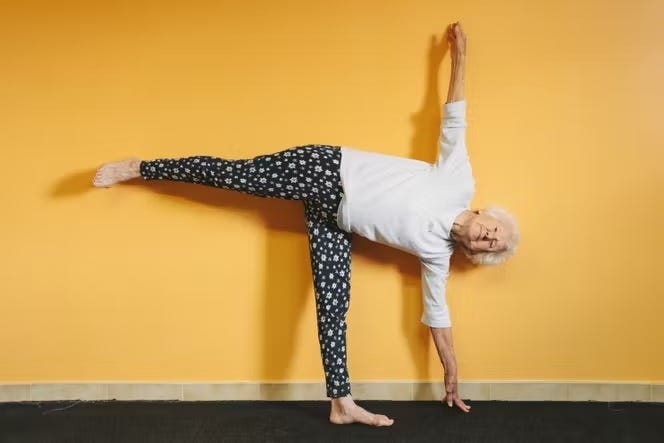
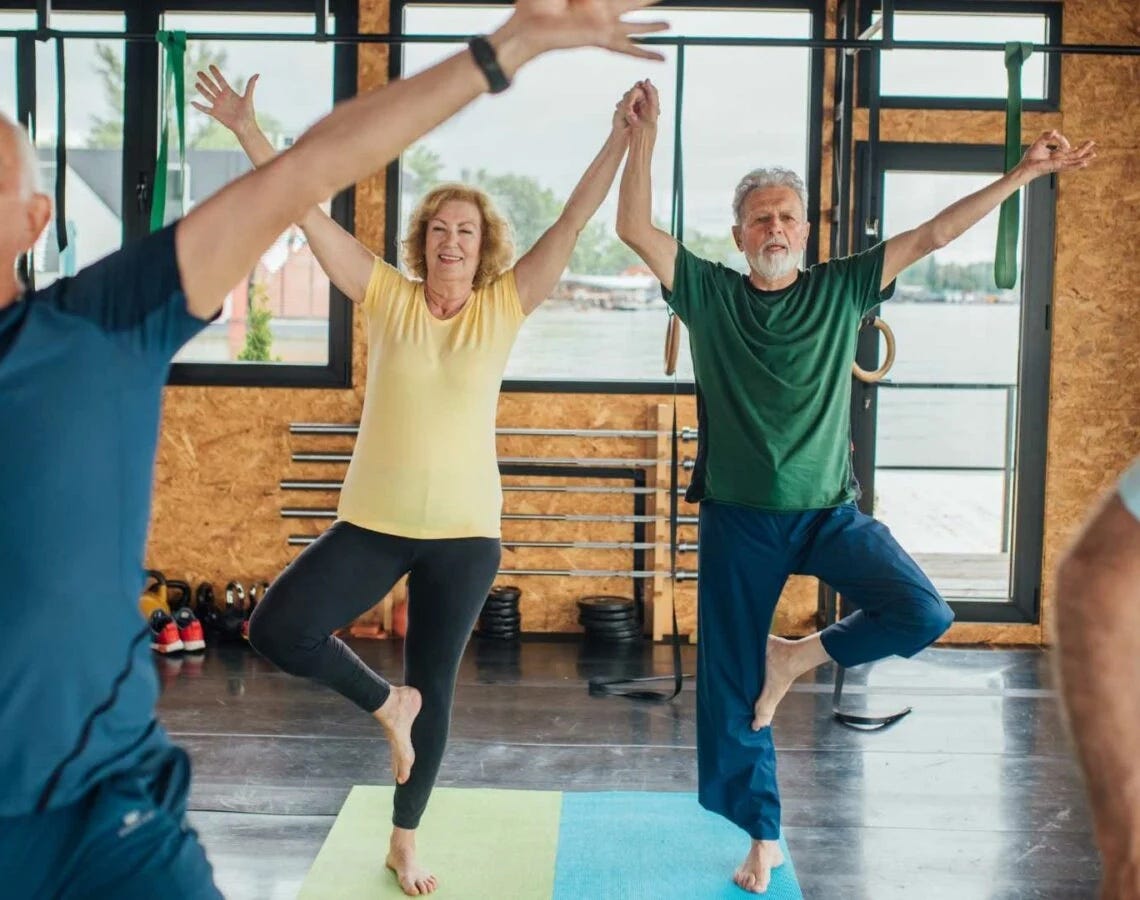
Balance is not simply something we automatically lose with age. It is a complex skill involving strength, coordination, proprioception, vestibular function, vision, confidence, and previous movement experience. Like many physical capacities, balance tends to improve when practised and decline when avoided. Research consistently shows that appropriately challenging movement programmes can improve balance and reduce fall risk in older adults.
This matters because many students become increasingly fearful of instability as they age. Over time, this can lead to less movement exposure, less confidence, and reduced adaptability. Yoga teachers can play an important role here. Balance training does not need to be extreme. Standing on one leg, changing visual input, transitioning slowly between positions, and practising weight shifts may all help maintain confidence and coordination.
👉2. Fear of falling can become more limiting than falling itself
Fear changes behaviour. When people become fearful of falling, they often begin moving more cautiously, reducing activity levels and avoiding challenge altogether. Over time, this can reduce confidence, strength, and physical capacity. This creates a self-reinforcing cycle where less movement may gradually lead to less confidence, which may then lead to even less movement.
This is one reason language matters so much in yoga spaces. Well-intentioned cues such as “be careful” or “don’t fall” may sometimes reinforce the idea that the body is fragile or unsafe. Building confidence is part of physical training. Teachers can help students gradually reconnect with challenge in ways that feel supportive rather than threatening.
👉3. Strength is one of the most important predictors of healthy aging
Strength is not simply about athletic performance. It supports balance recovery, metabolic health, resilience, independence, and the ability to tolerate the physical demands of everyday life. Lower strength levels are strongly associated with frailty, disability, falls, hospitalisation, and loss of independence.
Importantly, research shows that older adults can significantly improve strength through progressive resistance training, even into their 70s, 80s, and beyond (Fiatarone et al., 1990). This is especially important for women, many of whom were historically discouraged from strength training altogether.
Yoga can certainly contribute to physical function, but it may not always provide enough stimulus to optimise strength or bone health. Encouraging students to include resistance training alongside yoga may be one of the most valuable things we can do for long-term health.

👉4. Power may matter even more than strength
Strength is the ability to produce force. Power is the ability to produce force quickly. This distinction matters because many falls happen too fast for slow strength alone to help. The ability to react quickly, catch oneself, or step rapidly may be especially protective later in life.
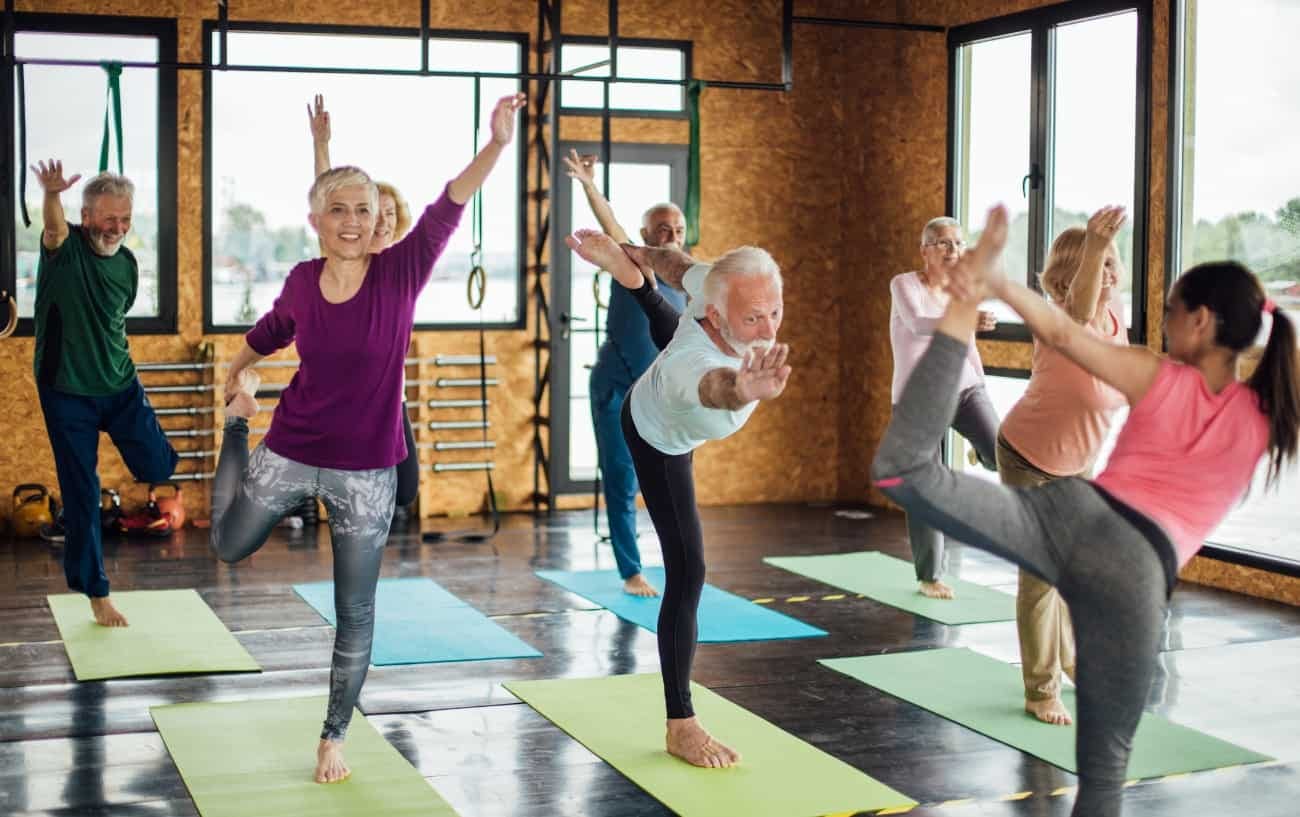
Research suggests that power often declines earlier and faster than strength as people age. This has led many researchers to emphasise the importance of maintaining movement speed and reactivity alongside strength itself. For yoga teachers, this may be a reminder that dynamic movement also has value. Faster transitions, stepping patterns, getting up from the floor, and appropriately scaled movement variability may all help support adaptability.
👉5. Pain does not always equal damage in aging bodies
Structural changes such as disc degeneration, osteoarthritis, and tendon changes become increasingly common with age, including in people without pain. Imaging findings are often poorly correlated with symptoms. Many older adults are told that age-related findings on scans explain their pain completely, even when those findings may simply reflect common human variation.
This can increase fear and reduce confidence in movement. Yoga teachers do not diagnose pathology, but we do influence beliefs around movement and safety. If we present aging tissues as inherently damaged or fragile, students may become increasingly protective and fearful of movement.
Capacity, confidence, and function often matter more than achieving “perfect” structure or posture.

👉6. Older adults are often underchallenged
Many older adults spend years being told to “take it easy”. While caution is sometimes appropriate, excessive simplification can unintentionally reduce opportunities for adaptation and growth. In many movement spaces, older students are underloaded rather than overloaded.
Aging does involve change. Recovery may be slower and tissues may tolerate load differently. But change does not automatically mean fragility. Appropriate challenge is not harmful. Underloading also carries risks.
The goal is not to push aggressively, but to help students maintain confidence, capacity, and adaptability for as long as possible.

👉Why this matters for yoga teachers
Yoga teachers help shape how people understand aging itself. Classes can either reinforce fear and limitation, or support resilience, confidence, and continued adaptability.
The goal is not to deny that aging bodies change. It is to recognise that many capacities remain remarkably responsive throughout life.
Can I ask you a quick favour? If you enjoyed this post, please tap the heart at the bottom of the email. This helps my writing reach more people.
Ready to deepen your applied anatomy knowledge and become more confident in your teaching?
Join me this weekend for my final in-person training of 2026!

References:
Fiatarone, M. A. et al. (1990). High-intensity strength training in nonagenarians. JAMA, 263(22), 3029–3034.
Levy, B. R. (2009). Stereotype embodiment. Psychological Science, 20(12), 1537–1543.
Livingston, G. et al. (2020). Dementia prevention, intervention, and care. The Lancet, 396(10248), 413–446.
